The work consists of only two pieces, so why does an hour feel too short?
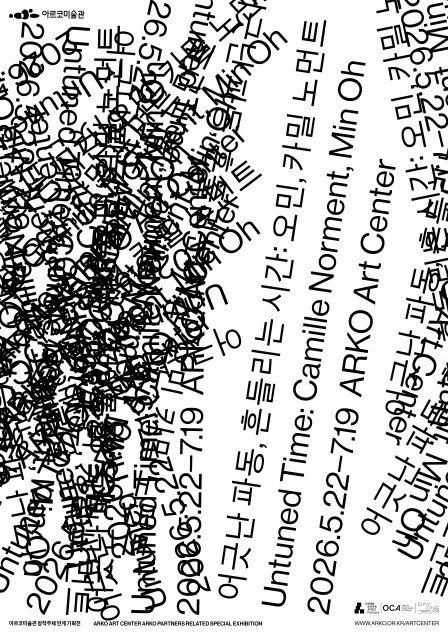
Before I entered the exhibition hall, I was a little puzzled. The entire ARKO Art Center's 1st and 2nd exhibition rooms are being used, yet there is only one work on the first floor and one on the second floor, just two pieces in total. But once I stood in front of Omin's video installation "Simultaneous" on the first floor, I changed my mind. In a dark room, nine screens speak at the same time, sounds overlap, and scenes interfere with one another. Seven videos shot on a film set run simultaneously, and altogether they amount to 150 minutes. If you try to follow only one screen, the one next to it keeps interrupting. At first, you might want to get annoyed by the "noise," but if you sit quietly for a while, the seemingly disconnected words suddenly connect with other screens. This is how the duo exhibition by Omin and Camille Normant, Broken Waves, Shifting Time, handles noise. It sees interference not as something to eliminate, but as something that hides more information and possibility within it. The exhibition runs from May 22 to July 19, 2026.

Second floor: a time to sit on a wooden structure and "hear sound with your body"
When you go up to the second floor, the atmosphere changes completely. It is Camille Normant's sound installation "Plexus (Rhizome) Seoul," and as the title suggests, a wooden structure spreads throughout the space like a rhizome. The piles of timber laid on the floor can be sat on like benches, and some pieces of wood rise along the wall or lean against each other and intersect, standing like an unfinished architectural form. The key point is that when you sit here, the vibrations of sound are transmitted through your body. Normant recorded the voices of various artists active in Seoul, such as gayageum singers, independent vocalists, choreographers, actors, and visual artists, and turned them into "music"; rather than being organized into a familiar melody, it reaches you as vibrations moving between the space, the structure, and your body. This work is a new commission produced by the ARKO Art Center, and it is the first time Normant's work has been presented at a museum in Korea. For reference, he was the representative artist for Norway's national pavilion at the 2015 Venice Biennale and received the Nam June Paik Art Award in 2023. Keep your shoes on and just sit on the wood to feel the vibrations. It is not often that you hear sound with your back and hips instead of your ears.

A half-day route starting from Exit 2 of Hyehwa Station
Getting there is easy. Take Subway Line 4 to Hyehwa Station and exit through Exit 2 (toward Marronnier Park). The building, designed by Kim Swoo-geun and made of red bricks, is easy to recognize from afar. There is no parking lot, so it is best to come without a car. The best part is the admission fee: the ARKO Art Center is free to enter (the fee may vary depending on the exhibition, so keep that in mind). Visiting hours are Tuesday to Sunday from 11:00 a.m. to 7:00 p.m., with extended hours until 9:00 p.m. on Wednesdays, and entry is allowed until 30 minutes before closing. It is closed on Mondays, so avoid planning a Monday visit. If you are arranging your route, I recommend a weekday afternoon or Wednesday evening, when it stays open later. Even if you cannot watch all 150 minutes of video, you will likely spend 30 to 40 minutes on the first floor and another 20 to 30 minutes on the second floor feeling the vibrations while sitting. When you come out, Marronnier Park and the cafes and theater street of Daehangno are right there, so the evening flows naturally from the visit. As long as you check the last train time from Hyehwa Station in advance, an evening visit is no burden.

What I told my foreign friends in advance
In fact, this exhibition has almost no language barrier. As the curator said, "You can enjoy it simply through your own senses without complicated theory or prior knowledge," so on the first floor you just experience the layering of light and sound, and on the second floor you simply experience the vibrations transmitted through your body. However, Omin's videos include a lot of Korean-language interviews and speech, so if you try to follow every line of dialogue, it can be frustrating if you do not know Korean. In that case, it is closer to the right way to enjoy this work to focus on the "sensory" experience of the screens colliding rather than chasing the meaning. And there is one important thing to know: this is an exhibition that you can truly feel only when you stay for a long time. It is not a place to rush through, snap a few photos, and leave; it is the kind of work that reveals itself only when you sit down and spend time with it, so go with plenty of mental space. Also, because it is a sound work, please note that it is not a headphone-style listening environment if you are sensitive to sound. During opening week, programs such as an improvisational collaboration between Normant and a cellist, Omin's performance art, and artist talks were also held, so I recommend checking the official page once for any linked programs and same-day operating details before your visit.
So, who is it for?
It is perfect for people curious about contemporary art such as sound, video, and installation, and for travelers who are tired of "fast-consumed content" and want to stand still in one place for a while. It is free and located in the heart of Daehangno, so it is also a good half-day course to drop by casually and then continue on to the park and theater district. After spending an hour in front of just two works without noticing how time passed, the word noise may sound a little different.
| Item | Score | Basis |
|---|---|---|
| Language accessibility | 3.5 | Designed to be enjoyed through the senses without theory, but the Korean speech in Omin's videos may feel a bit frustrating for non-Korean speakers |
| Transport accessibility | 5.0 | A red-brick building within walking distance from Exit 2 of Hyehwa Station on Line 4, in the center of Daehangno |
| Convenience for foreign visitors | 3.0 | A public art museum with good access, but information on foreign-language guidance is limited |
| Local cultural experience | 4.5 | Experience contemporary sound and video art in Daehangno, including Camille Normant's new work introduced in Korea for the first time |
| Value for money | 5.0 | Free admission (fees may vary by exhibition), long stays possible |
| Cleanliness/Safety | 4.0 | Well maintained as a national/public museum, but the dark video rooms and wooden structures require attention to the route |
| Food/amenities | 4.0 | Food inside the museum is limited, but Marronnier Park and Daehangno cafes and restaurants are plentiful right outside |
This article was compiled by our editorial team from official announcements and coverage of previous editions; it is not a first-hand visit report. Please confirm the final schedule and fees on the official website.
Festival Details
-
Festival Period5/22/2026 ~ 7/19/2026
-
Festival VenueArko Museum of Art Rooms 1 and 2 Exhibition Halls
-
Operating HoursTuesday~Sunday, 11:00-19:00 (Admission available until 18:30) Wednesday, 11:00-21:00 (Admission available until 20:30)
-
Admission FeeFree
-
TagsO Min Camille Norment Two-Person Exhibition Time-Based Installation Sound Installation Arko Museum of Art
More Festivals




Popular Concerts

![EXO PLANET #6 - EXhOrizon [dot] -](https://kotourlive-images.s3.ap-northeast-1.amazonaws.com/concerts/1787215796640_ee65f451_thumbnail.jpg)

More Travel Guides in This Area
 Travel Guide
From the Camel-Back Ridge to Heunginjimun Gate: Reading Seoul's City Wall at Naksan Park
 Travel Guide
Walking Along the Traces of Daewongak in Seongbuk-dong’s Gilsangsa
 Travel Guide
Reading the History of Hanyangdoseong from 1396 beside Heunginjimun Gate: Seoul City Wall Museum
 Travel Guide