A museum where writing becomes art, starting from Hagye Station on Subway Line 7
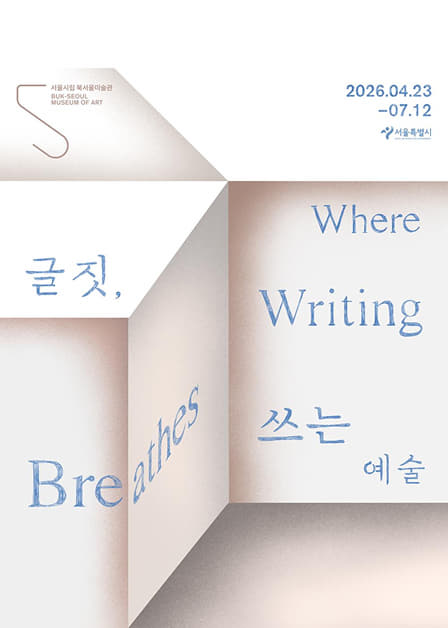
I visited the Buk-Seoul Museum of Art, located in Junggye-dong, Nowon-gu, at the far northeast end of Seoul. A Korean friend told me, "There’s an exhibition where you read writing like a painting," so I went half in doubt, but once I got there, it really was exactly that. "Lettering, Writing as Art" runs from April 23 to July 12, 2026, in Exhibition Rooms 1 to 4 on the first and second floors, as well as Byeol Madang. Usually in a museum, text is the explanation next to a work. But here it’s the opposite: the text itself becomes the skeleton of the work and the main character rather than an explanation. Ten artists or teams — Kim Young-geol, Noh Seok-mi, Seoul Express, Ahn Kwang-hwi, Ahn Kyuchul, Um Yoo-jung, Lee Min-seon, Cho So-hee, Cha Ji-ryang, and Cha Hye-rim — participate, and around 340 works unfold through sound, text, drawing, painting, sculpture, installation, and video. From a word scribbled by hand to short sentences, poems, novels, scripts, and song lyrics, the writing created by the artists transforms into paintings in some cases, and in others into music wrapped in sound.

How a solo foreign visitor can get to the Buk-Seoul Museum of Art
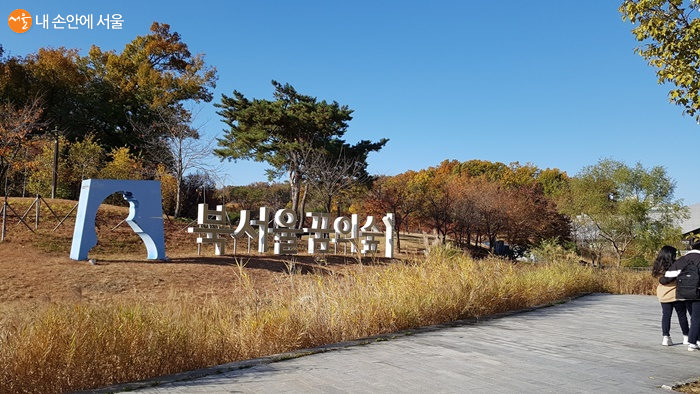
The starting point is Hagye Station on Subway Line 7. Exit 1 brings you to the museum after about 350 meters, and it takes only 7 to 8 minutes on foot at a relaxed pace. Since Line 7 passes Gangnam-gu Office and Express Bus Terminal, if you’re staying in the Gangnam area, it’s convenient because you can get there directly without transferring. The museum sits on a hill in the park, so the final stretch involves a slight uphill walk, which actually made it feel as if I were suddenly entering a forest in the middle of the city. I was glad I wore sneakers. You don’t need to worry about admission fees. Since it is a branch of the Seoul Museum of Art, this exhibition can be entered without a separate ticket, and advance reservation is not required. Just go during opening hours and enter through the entrance.
However, the opening hours vary by day and season. On weekdays it is open from 10:00 a.m. to 8:00 p.m.; on weekends it stays open until 7:00 p.m. in the summer season (March to October), with last admission at 6:00 p.m. It is closed every Monday and on January 1. Also, on the first and third Fridays of every month, it stays open until 9:00 p.m. for "Seoul Culture Night." If you want to take your time in the evening and enjoy it as a night outing, aim for those Fridays. English guidance is not especially abundant, so it’s best to expect only bilingual display of exhibition titles and artwork descriptions. Still, since the exhibition’s theme is writing, there are many Korean text-based works. Even so, because they are arranged to be seen through shape and rhythm, there was no major problem in sensing the "gesture of writing" visually even without reading Hangul.

At the exhibition hall: the moment when text becomes sound and sculpture
Once you enter the exhibition hall, you quickly realize this is not the kind of exhibition you just breeze through. You have to read the writing for the works to open up. There are new works supported by the museum for production, such as Cha Ji-ryang’s Empty Orchestra, and works that began as text, like Ahn Kwang-hwi’s Dialectic and Um Yoo-jung’s Body, Face, Plant, Volume series, transformed into painting, drawing, and installation. Even within the same exhibition, some rooms are quiet with sentences on paper, while others pulse with rhythm and reverberate as sound, completely changing the mood. It is like watching hazy images in your mind become clear as you write, and because you look into that process artist by artist, you end up lingering in front of each work for a long time.
There is also a cafe and an art library inside the museum, so it’s a nice place to take a break in the middle. The art library operates from Tuesday to Saturday, 10:00 a.m. to 6:00 p.m., and is closed on Sundays, Mondays, and public holidays, so if you want to look at catalogs or books, I recommend going on a weekday afternoon. Wheelchair rentals, an elevator, and foldable museum chairs are available, so if your legs get tired, you can carry a chair around and sit down to look. Payment at both the cafe and gift shop can be made by card and mobile pay, so there was no need to carry cash separately.

Practical tips to know before you go, so you get less lost
This is an exhibition you read, so it takes more time than you might expect. If you follow the writing, one round can easily take more than two hours. So if you go in right before closing, you won’t be able to see everything. Remember that last admission is one hour before closing. On weekend afternoons, it gets crowded with families, so if you want to focus quietly on the text, weekday mornings or Culture Night evenings are much more relaxed. Programs such as artist talks linked to the exhibition may require separate application, so if you want to participate, check the schedule on the official page in advance.
- Nearest station and exit: Subway Line 7, Hagye Station, Exit 1, 7 to 8 minutes on foot (gentle uphill at the end)
- Closed: Every Monday, January 1
- If you want to stay late: First and third Friday of every month, "Culture Night" until 9:00 p.m.
- Estimated visit time: 1.5 to 2 hours or more if you read slowly; last admission is one hour before closing
Recommended for these people
If you like contemporary art or are looking for an exhibition that makes you think rather than just a flashy photo spot, you’ll definitely like this one. It’s even better if you’re interested in writing, language, or literature. On the other hand, if your schedule is just for quick snapshots and a short stop, it may feel a bit calm and subdued. As a half-day course that takes you slightly away from the city center to walk through a park and a museum together, I recommend experiencing another side of Seoul.
| Item | Score | Basis |
|---|---|---|
| Language accessibility | 3.0 | English is provided, but the exhibition is centered on Korean text; however, the form and rhythm of writing can still be sensed nonverbally |
| Transport accessibility | 4.0 | 7 to 8 minutes on foot from Exit 1 of Hagye Station on Line 7, accessible from the Gangnam area without transferring |
| Facilities for foreign visitors | 3.5 | Wheelchair rental, elevator, and museum chairs available; card and mobile pay accepted |
| Local cultural experience | 4.0 | Contemporary art dealing with the Seoul Museum of Art institutional theme of "creation," with many new works by 10 Korean artists or teams |
| Value for money | 4.5 | A city museum exhibition you can view without a separate ticket or advance reservation |
| Cleanliness/Safety | 4.0 | An eco-friendly museum connected to the park, with well-maintained exhibition rooms and rest areas |
| Food and conveniences | 3.5 | An on-site cafe and art library are available, though the library is only open during the day from Tuesday to Saturday |
This article was compiled by our editorial team from official announcements and coverage of previous editions; it is not a first-hand visit report. Please confirm the final schedule and fees on the official website.
Festival Details
-
Festival Period4/23/2026 ~ 7/12/2026
-
Festival VenueSeoul Metropolitan Government Northern Seoul Museum, Floors 1 and 2 Exhibition Rooms 1, 2, 3, 4, Byeol Madang (Star Courtyard)
-
Operating HoursTue/Wed/Thu 10:00–20:00, Fri 10:00–21:00, Weekends and public holidays 10:00–19:00 ※ Closed on Mondays
-
Admission FeeFree
-
TagsSeoul Metropolitan Government Museum of Art Creation (2026 institutional agenda) Writing Artist Literature and Art Exhibition Space
More Festivals
Popular Concerts
![EXO PLANET #6 - EXhOrizon [dot] -](https://kotourlive-images.s3.ap-northeast-1.amazonaws.com/concerts/1787215796640_ee65f451_thumbnail.jpg)
More Travel Guides in This Area
 Travel Guide
Choansan Mountain — From a Resting Place for Eunuchs to Nowon’s Hydrangea Garden
 Travel Guide
23 m from Exit 1 of Nowon Station, choose 10·12·14-piece sushi at Sangmu Sushi Nowon Station branch
 Travel Guide
From the Northern Judicial Complex in 1974 to the Seoul Museum of Living History in 2019, a record of everyday Seoul just 3 minutes from Taereung Entrance Station
 Travel Guide