I’ve been here?
Your check-in helps the next traveler.
No one has checked in yet Be the first
One tap — no writing needed
17 minutes from in front of Daehanmun to 18th-century Hanyang
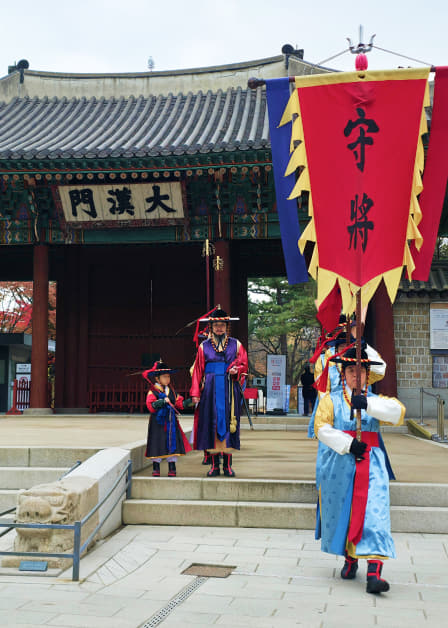
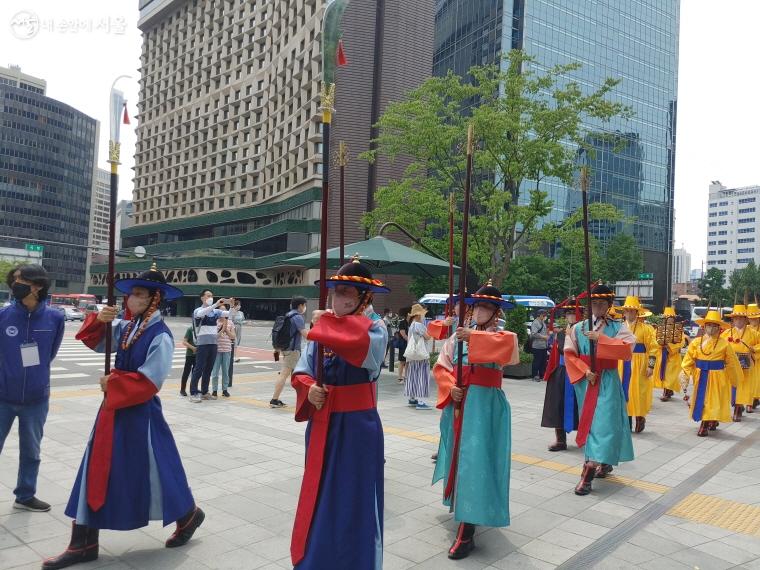
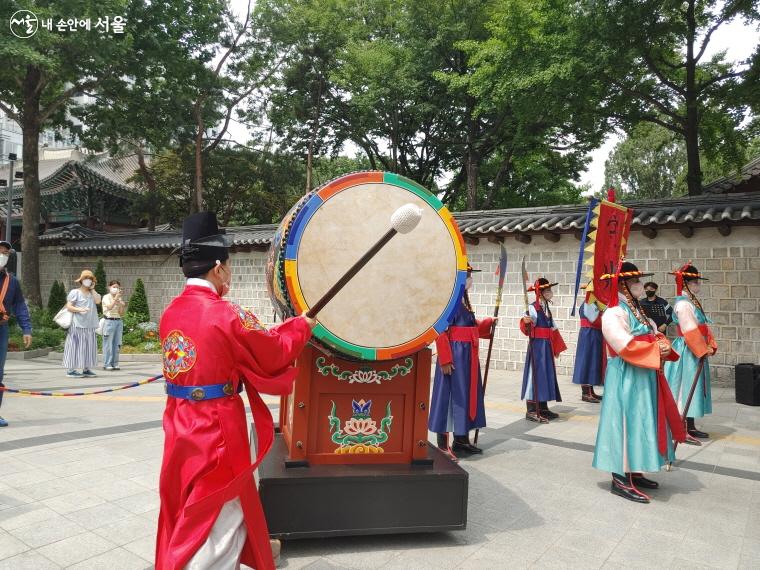
The square in front of Daehanmun, the main gate of Deoksugung, is usually just the middle of the city. But as 11:00 a.m. gets closer, the atmosphere changes. Guards in red and blue uniforms line up and enter, and on one side the drum major carrying a large drum takes his place. I first wondered if this was some kind of performance, but the moment the drum sounded three times and cut across the square, I really felt as if time had slipped back one notch. The Royal Guard Changing Ceremony is an event that recreates the scene of the guard unit changing shifts at the palace gate during the Joseon Dynasty. It is a traditional Korean cultural event that Seoul City has recreated in front of Daehanmun at Deoksugung since 1996 after expert historical verification, and it is often compared to the changing of the guard at Buckingham Palace in the United Kingdom. It is not a direct reproduction of an actual Joseon ritual, but rather a kind of faction that reconstructs the shift procedure that would have been repeated daily in front of the palace gate by bringing in actual posts and figures, based on expert historical research.
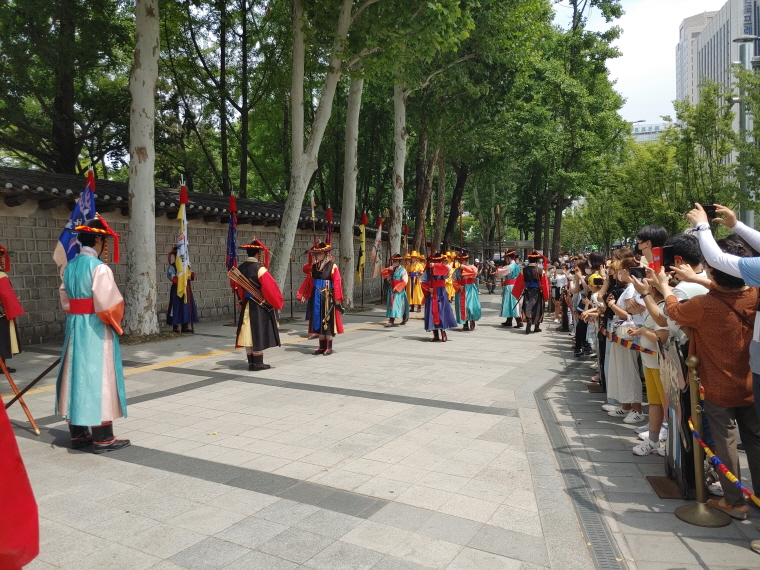
The ceremony is more detailed than you might expect. The drum major signals the start by sounding the drum three times, and when the chief recorder of the Royal Secretariat informs the guardsman of the password approved by the king, an assistant official asks for and answers the password to verify the identity of the guard unit being exchanged. Next, the newly appointed guards report for duty to the guardsman, and with six drum beats, they hand over the small box containing the palace gate key. At the end, after the command 'Saeom,' the drum sounds twice and the guards on both sides face each other for a face-to-face handover. Even if you do not know Korean, you can follow the flow just by watching the drums, flags, and movement paths, so my foreign friends were able to stay focused all the way to the end.
Route for foreign travelers: start from Exit 2 of City Hall Station
Before you go, just keep one thing in mind. This is an outdoor event that anyone can watch for free from the street without an admission ticket. So there is no reservation and no need to worry about sold-out tickets. However, if you miss the time, you simply miss it, so the only thing that matters is keeping track of the start time. Taking the subway is the most convenient way to get there. From Exit 2 of City Hall Station on Lines 1 and 2, it is a 2-minute walk to Daehanmun, almost right in front of the exit. If you come from the Gwanghwamun Station side on Line 5, it is about a 10-minute walk from Exit 6. By bus, get off at the 'City Hall Front & Deoksugung' stop.
The changing ceremony runs from Tuesday to Sunday, except Mondays. The operating times vary by season and are usually either two sessions at 11:00 and 14:00, or three sessions at 11:00, 14:00, and 15:30, so I recommend checking the official page on the day of your visit. When I went, it was the 11:00 a.m. session, and because there were fewer people than at midday, I could watch comfortably from the front row. One thing worth knowing is that on Saturdays, afternoon performances (14:00 and 15:30) may be canceled because of rallies in front of Daehanmun, but the 11:00 a.m. event still takes place. Also, the event is suspended during extreme heat or cold, or on snowy or rainy days, and when emergency air-quality reduction measures are in effect. So in the height of summer or winter, or on a bad-weather day, it is better not to force it into your schedule and instead plan something else around it.
There is no separate entrance line or ticket check on site. You can stand along the edge of the square to watch, but you cannot enter the inner area of the event route, so the key is to arrive 10 to 15 minutes early and secure a good spot facing the front or side. Since there is no long English announcement, you may not know the detailed names of each step unless someone explains them beside you. Still, the scenes unfolding like a live screen are so intuitive that I was completely satisfied just taking photos and videos. After it ends, I recommend going straight into Deoksugung. If you enter right after watching the ceremony, the route stays neat and efficient.
Experience programs where you can become a guardsman yourself: 'I Am a Guardsman' and 'Gaesik Tago'
The reason this event is not just for sightseeing is its experience programs. The one that interested me most was 'Gaesik Tago,' where you can actually beat the drum yourself. There are many reviews saying that becoming the drum major and sounding the large drum creates a deep, resonant sound that shakes your chest, and in fact the low tones filling the square are quite powerful. The 'I Am a Guardsman' program, where you try on the role of a guardsman, and the audience-style ceremonial welcome where you receive an appointment certificate and an identification badge, are especially well received by foreigners.
- I Am a Guardsman / Gaesik Tago: operated during the changing ceremony time from Tuesday to Sunday, 1 person per session, includes wearing the uniform and role training, advance application required
- Arrive at the waiting room 1 hour before for I Am a Guardsman, and 30 minutes before for Gaesik Tago
- Traditional attire experience: weekends and public holidays from 10:30 to 15:30, no limit on the number of participants, wear traditional clothes and take photos for free on site
- A Special Day in My Life: Tue, Wed, and Fri at 10:00, 13:00, and 15:00, 1 group per session (up to 5 people), instant photo provided after a commemorative photo with the guardsman
One important thing to know here is that 'I Am a Guardsman' and 'Gaesik Tago' are limited to one person per session and require advance application. You cannot just show up and say, 'I want to try it today'; you must apply in advance and arrive at the waiting room before the scheduled time. On the other hand, the traditional attire experience operated on weekends and public holidays lets you try on the clothes for free on site without an application, so if you failed to make a reservation, this is the least burdensome option. For the 'A Special Day in My Life' photo session, costumes, props, and makeup are not provided, and you cannot take photos while the guards are moving, so it is best to keep to the designated session time.
Half-day course combined with Deoksugung and Jeongdong-gil
Just watching the changing ceremony would be a shame, because the surrounding area is too good to miss. After the ceremony, you can go straight into Deoksugung. For visitors aged 25 to 64, admission is 1,000 won, and you can enter for free if you are wearing hanbok. With just one 1,000-won ticket, you can see Seokjojeon Hall, Junghwajeon Hall, and Jeonggwanheon Pavilion, so the value for money speaks for itself. Deoksugung is the only royal palace in Seoul that stays open until night, so it is nice to watch the changing ceremony during the day, stroll along Jeongdong-gil, and then return in the evening to see the night view. Jeongdong-gil, which starts at Daehanmun, is a walking path that leads to the Seoul Museum of Art, Jeongdong Observatory, and the former Russian Legation, making it a pleasant place for a slow walk.
Food and convenience are not a problem either. The area around City Hall Station and Deoksugung has restaurants clustered within a 3- to 4-minute walk, and the basement food courts in the buildings near City Hall are also close by. Since this is a downtown area where cards and mobile payments are naturally accepted, there is no need to carry cash separately. However, restaurants get crowded during lunchtime and on weekends, so I recommend going a little off peak. Restrooms and places to rest can be handled by entering Deoksugung, so the route of watching the ceremony and then entering the palace is convenient in many ways.
I confidently recommend this to foreign friends who are beginning to learn Korean history, families looking for a free activity to enjoy with children, and anyone who wants to take photo-worthy pictures in downtown Seoul. With no reservation and no admission fee, just standing on the street lets you see an 18th-century palace gate scene unfold before your eyes, so if you leave one 11 o'clock slot open in your Seoul itinerary, it will definitely be a memorable experience.
| Item | Score | Basis |
| Language accessibility | 3.0 | There is no long English announcement, but the drums, flags, and movement route are intuitive, so the flow can be understood even without language. |
| Transportation access | 5.0 | 2 minutes on foot from Exit 2 of City Hall Station on Lines 1 and 2; buses and Gwanghwamun Station are also nearby |
| Facilities for foreigners | 3.5 | As an outdoor free event, the entry process is simple, and restrooms and rest can be handled inside Deoksugung |
| Local cultural experience | 4.5 | In addition to the Joseon changing ceremony recreation, you can directly experience the guardsman role, Gaesik Tago, and traditional attire |
| Value for money | 5.0 | Viewing is free, and Deoksugung is also affordable at 1,000 won admission with free hanbok entry |
| Cleanliness/Safety | 4.0 | Held in a city square, and the event is suspended during rain, extreme cold, or extreme heat for safety reasons |
| Food/Convenience facilities | 4.0 | Restaurants are concentrated within a 3- to 4-minute walk from City Hall Station and Deoksugung, and cards/mobile payments are widely accepted |
This article was compiled by our editorial team from official announcements and coverage of previous editions; it is not a first-hand visit report. Please confirm the final schedule and fees on the official website.
Festival Details
-
Festival Period1/1/2026 ~ 12/31/2026
-
Festival VenueIn front of Deoksugung’s Daehanmun Gate
-
Operating HoursTwice daily: 11:00 and 14:00 (excluding Mondays)
-
Admission FeeFree
-
TagsDeoksugung Seoul Royal Palace Gateguard Changing Ceremony Gateguard Soldiers Traditional Costume Experience Gae-sik Tago Experience I Too a Gateguard
More Festivals


Popular Concerts
![EXO PLANET #6 - EXhOrizon [dot] -](https://kotourlive-images.s3.ap-northeast-1.amazonaws.com/concerts/1787215796640_ee65f451_thumbnail.jpg)
More Travel Guides in This Area
 Travel Guide
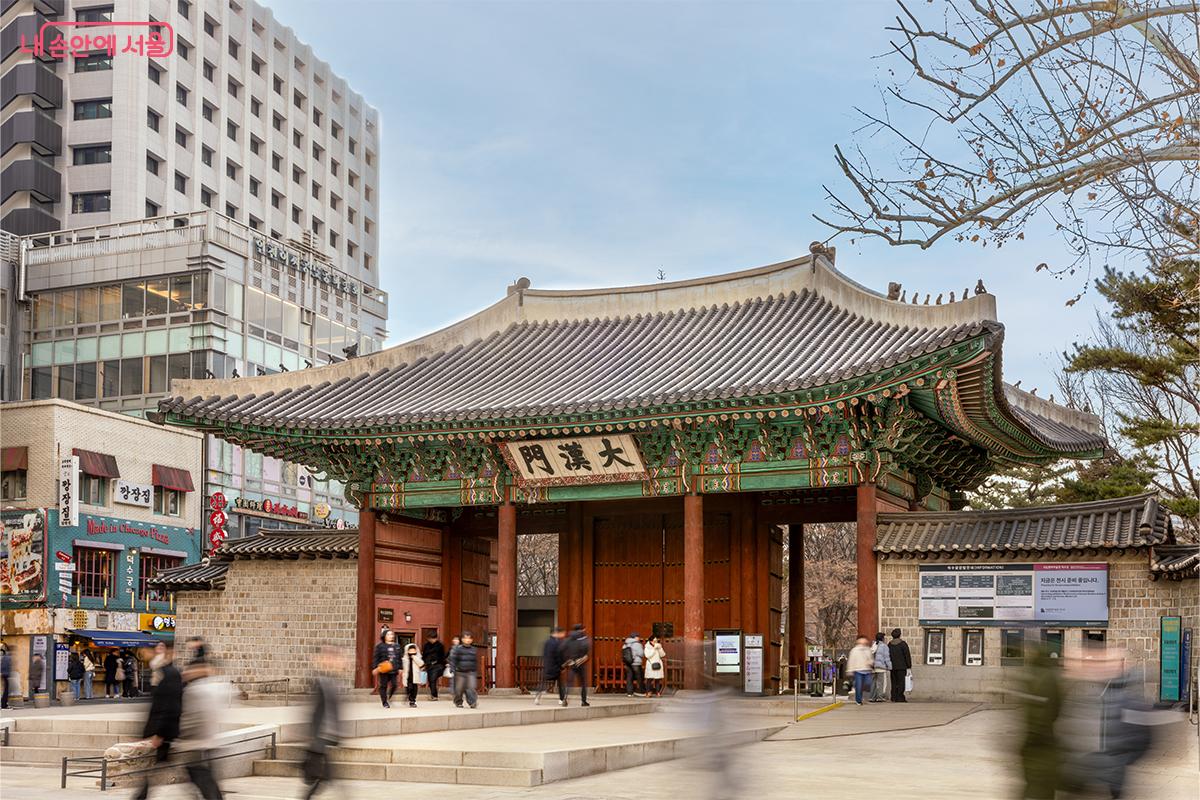
From Daehanmun Gate to Seokjojeon: A 90-Minute Journey Through the Last Imperial Palace of the Korean Empire
 Travel Guide
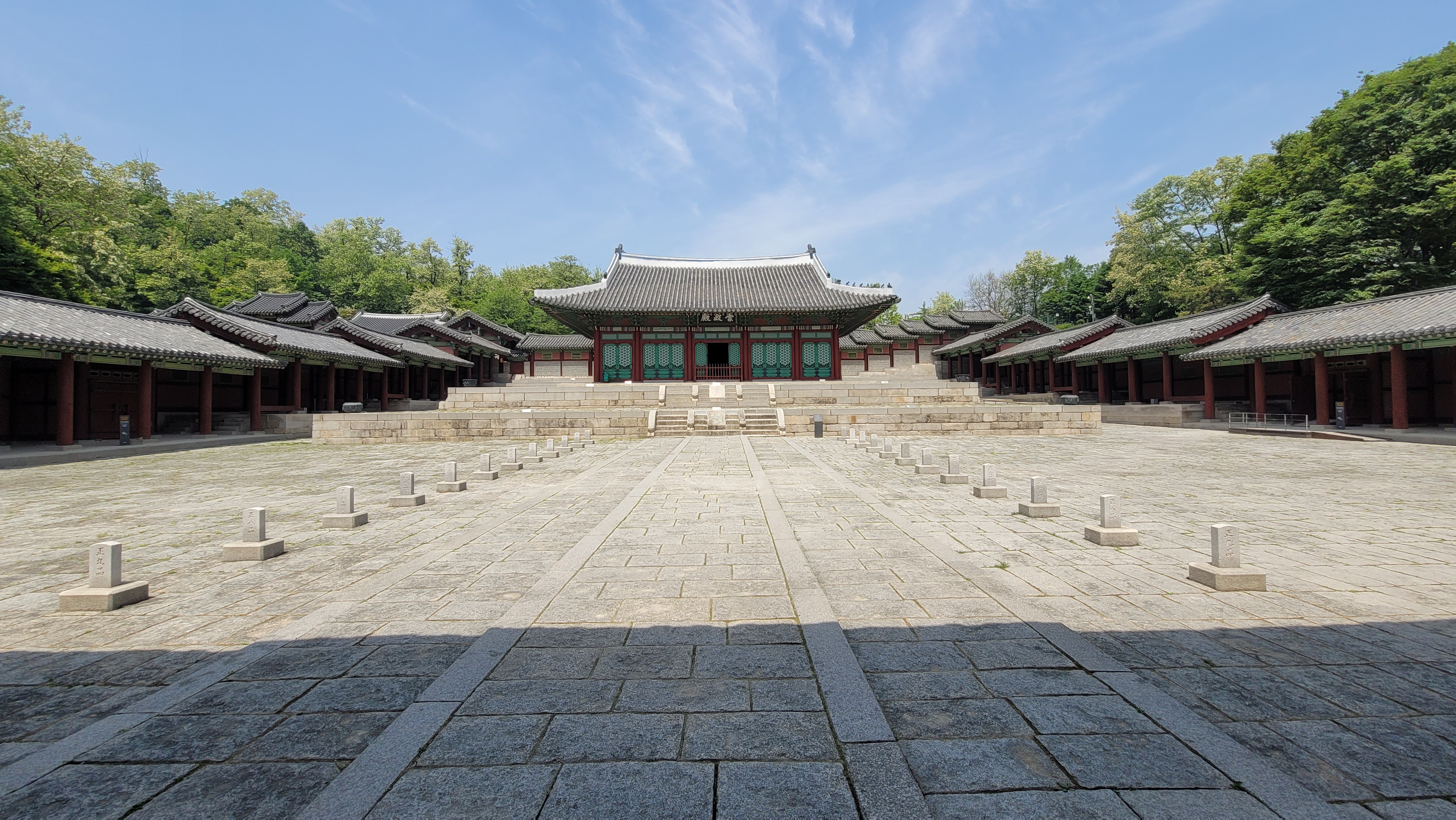
Gyeonghuigung Palace: A 60-Minute Walk Along the Axis of the Vanished Western Palace
 Travel Guide
Reading Seoul’s Future Three Floors Underground at the 1937 Postal Bureau Site
 Travel Guide