The 9.8 km Path Where Leaves Are Not Swept, Palgongsan Buiinsa Walking Trail
Daegu Olle Palgongsan Course 3 is a one-way 9.8 km walking trail that starts from Gongsan Elementary School and Migok Village, and leads through Yongsudong Dangsan, Sutaegol, a leaf-covered street, and Buiinsa. It connects a historic temple and rural village paths, but there is little shade and the route continues uphill, so an early morning departure in spring or autumn is ideal.

I’ve been here?
Your check-in helps the next traveler.
19 people viewed this week Be the first
One tap — no writing needed
Actual Direction of the 9.8km One-Way Trail Opened in August 2009
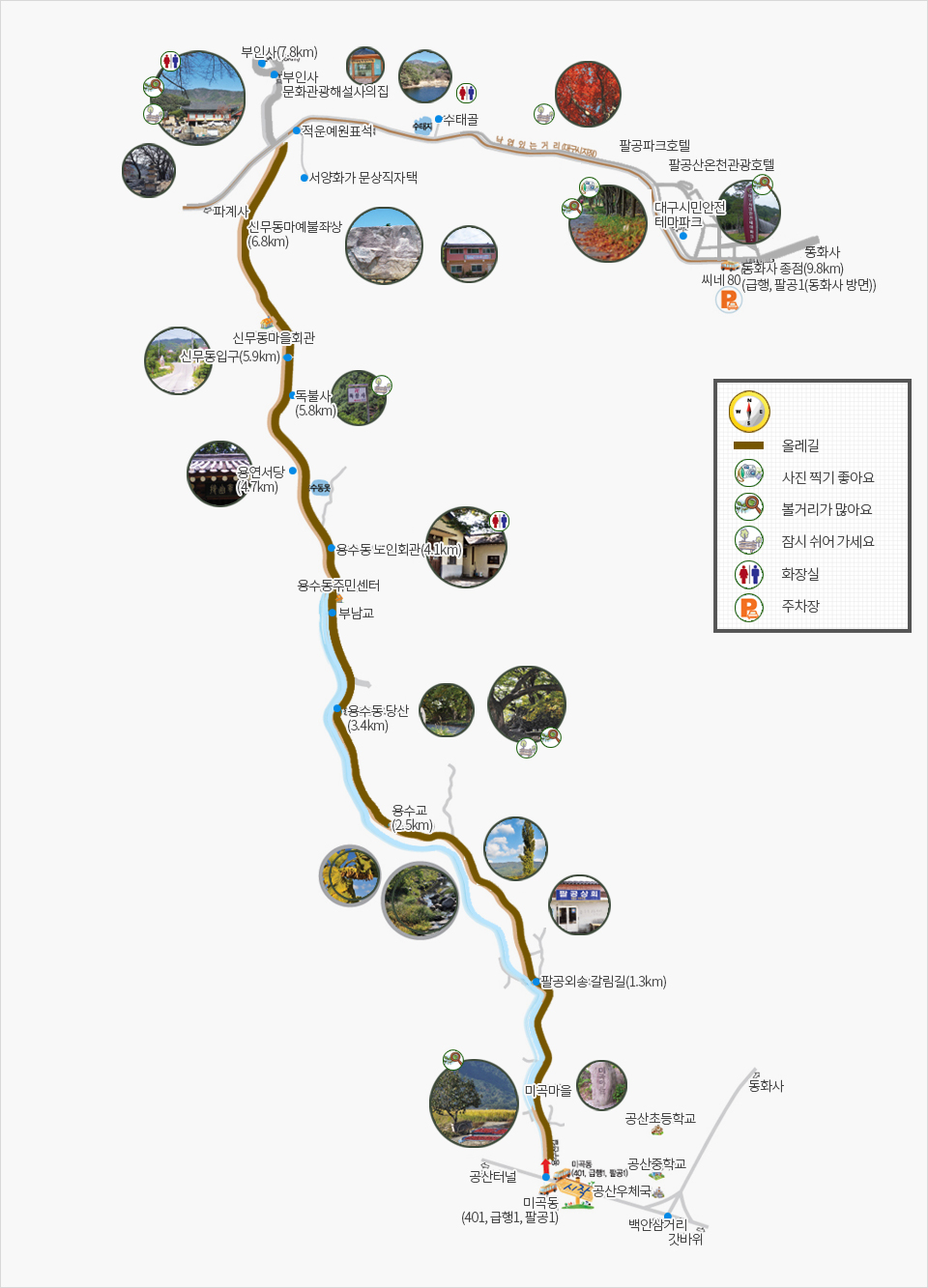
The Palgongsan Daegu Olle Course 3, known as the 'Buinsa Walking Path,' is a trekking course that opened in August 2009. The representative route according to official guidance is: Donghwasa Collective Facility Area - Palgongsan Circular Road Tree-lined Path - Buinsa Temple - Sinmu-dong Seated Rock-carved Buddha - Dokbulsa Temple - Nong-yeonseodang - Yongsu-dong Dangsan - Yongsugyo Bridge - Palgong Wasong Fork - Soyeon’s Eco Farm - Migok-dong Entrance. The total length is 9.8km, and the standard duration is approximately 3 hours and 30 minutes.
The Daegu City Culture & Tourism page also introduces the route as: Gongsan Elementary School → Migok Village Olle → Yongsu-dong Dangsan → Sutaeli → Street with Fallen Leaves → Buinsa Temple. Since the starting and ending points vary by guide material, it is safer when using public transport to decide on a one-way route starting from the Gongsan Elementary School/Migok-dong area and walking toward Buinsa Temple and the Donghwasa Facility Area, checking the return bus stop in advance.
Gongsan Elementary School's 1922 Starting Point and Yongsu-dong Dangsan
Gongsan Elementary School, which the course passes through, is recorded to have opened in 1922. In Migok Village, you walk along the Yongsuchen stream, and at Yongsu-dong Dangsan, rituals were traditionally held at dawn on the first full moon of the lunar year to pray for the village's peace and longevity. Although this Dangsan-gut (shamanistic ritual) disappeared with the start of the Saemaul Movement, the Dangsan site itself remains.
The name Migok is said to come from the abundance of rice (mi-gok) produced there. Therefore, this path is not a hiking trail leading directly to a mountain peak, but a walking trail centered on the history of daily life, connecting the Yongsuchen stream, village shrines, farm roads, circular roads, and temples. Yongsu-dong Dangsan and the Street with Fallen Leaves are also designated as photo zones for Course 3 by Daegu City.
Seasonal Conditions for the 'Street with Fallen Leaves' Starting from Sutaegol
The section of the Palgongsan Circular Road from the Sutaegol entrance toward Buinsa Temple is designated as the 'Street with Fallen Leaves' by Daegu City. During the foliage season, it is managed by leaving the fallen leaves on the ground without sweeping them. Official data suggests spring and autumn as the best times to visit this trail.
Conversely, mid-summer is not recommended. It is noted that the direction from Migok-dong toward Buinsa Temple consists of continuous uphill sections with little shade on the road. For a schedule of walking 9.8km in about 3 hours and 30 minutes, you will need more than 1L of water, a hat, and UV protection. During the foliage season, it is better to choose sneakers or trekking shoes with good grip to prevent slipping on wet leaves.
Buinsa Temple and the 1,715 Plates of the First Tripitaka Koreana: Memories of Goryeo
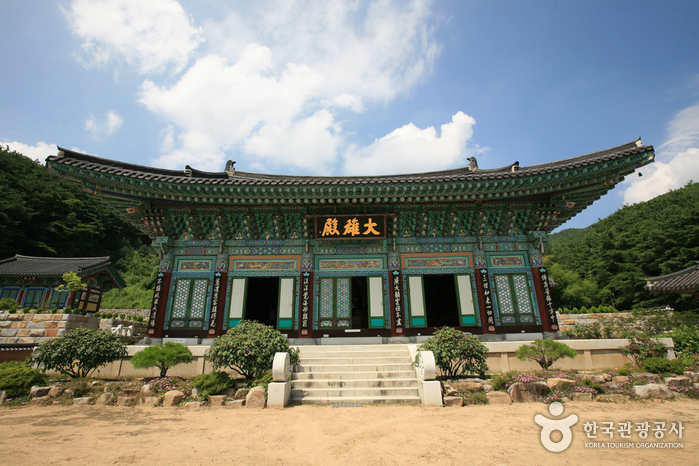
Buinsa Temple is a branch temple of Donghwasa, the head temple of the 9th District of the Jogye Order of Korean Buddhism. Its address is 967-28 Palgongsan-ro, Dong-gu, Daegu. The exact founding date is not confirmed, but it is presumed to have been founded during the reign of Queen Seondeok of Silla, and it houses Sungmojeon Hall, which honors her. It is said that every year on the 15th day of the 3rd lunar month, Sinmu-dong residents, the temple, and the Gyeongju Kim clan jointly hold the Queen Seondeok Memorial Ceremony.
It is known as the place where the Dogam (supervising office) was established to carve the First Tripitaka Koreana (Chojo Daejanggyeong) during the reigns of King Hyeonjong to King Munjong of Goryeo. According to guide materials, it once managed 39 subordinate hermitages and approximately 2,000 monks. Among the woodblocks of the First Tripitaka Koreana, most of which were lost during the Mongol invasions, the remaining 1,715 plates are kept at Nanzen-ji Temple in Kyoto, Japan. The current temple was rebuilt in 1959 after being burned down during the Korean War.
Distinguishing Buinsa Temple (10:00~17:00) from the Free Olle Trail
Palgongsan Daegu Olle Course 3 itself is open year-round with no operating hour restrictions and free admission. For inquiries about the course, contact the Palgongsan Experience Culture Program Operation Center at 053-985-8030, and for the Daegu City department in charge, contact the Forestry and Greenery Management Division at 053-803-4346. It is noted that restrooms on the path can be found at Buinsa Temple, so it is better to use them before starting.
However, one must distinguish between the trail and the temple grounds' information. Based on tourist guidance, Buinsa Temple's operating hours are 10:00~17:00, and the inquiry number is 053-982-5006, open year-round. Entry to Buinsa itself is free and parking is available, but the road to the temple entrance is narrow, making access difficult for large vehicles. While the course can be used at any time, if you intend to visit the temple interior, it is recommended to arrive between 10:00 and 17:00.
How to Enter via Bus 101-1 from Ayanggyo Station Exit 2
For public transportation, Daegu City guidance suggests taking bus 101-1 from the bus stop in front of Ayanggyo Station Exit 2 (Line 1). Also, the access methods provided are getting off at Jimyo-dong for bus 101, and getting off at Pagyegyo for bus 101-1. Express 1 and Palgong 1 also run toward Donghwasa Temple, which can be utilized if you set the Donghwasa Collective Facility Area as your starting or ending point.
Car users can park at Buinsa Temple but should consider the narrow width of the entrance road. Since it is a 9.8km one-way course, returning to the starting point is not easy if you only bring one car. It is practical to decide whether to leave the car at the Donghwasa Facility Area or Migok-dong, use two cars, or complete the one-way walk and return by bus.
For Those Who Want to Walk to Sinmu-dong Seated Rock-carved Buddha and Nong-yeonseodang
After Buinsa Temple, the path passes the Sinmu-dong Seated Rock-carved Buddha, Dokbulsa Temple, and Nong-yeonseodang. Official course descriptions introduce the Sinmu-dong Seated Rock-carved Buddha as a relic from the early Goryeo period and Nong-yeonseodang as a place where scholars studied. Unlike a schedule that only visits a single temple, walking Course 3 to the end allows you to experience Buddhist heritage, Confucian educational spaces, and traces of village rituals together.
On the other hand, it may not be suitable for those planning to move the entire 9.8km section with a stroller or wheelchair. While Buinsa Temple itself provides barrier-free information such as disabled restrooms, disabled parking areas, and no steps at the main entrance, Course 3 includes uphill sections, farm roads, and circular road sections with little shade. For accessibility purposes, it is appropriate to adjust the scope to a short visit centered on the Buinsa Temple grounds and walk the entire course with a companion who is capable of walking.



Before You Go
- Address
- 428-1 Yongsu-dong, Dong-gu, Daegu
- Hours
- Daegu Olle Course 3 open 24/7 (no time limit). Buinsa Temple: 10:00~17:00 based on tourist guidance.
- Closed
- Daegu Olle Course 3 open year-round. Buinsa Temple open year-round.
- Admission
- Free
- Phone
- Daegu Olle Inquiry: 053-985-8030 / Buinsa Temple: 053-982-5006
- Official site
- https://www.daegu.go.kr/cts/?menu_id=00000878
- Transport
- Use bus 101-1 in front of Ayanggyo Station Exit 2 (Line 1). Bus 101 get off at Jimyo-dong, bus 101-1 get off at Pagyegyo. Express 1 and Palgong 1 operate toward Donghwasa.
- Parking
- Parking available at Buinsa. Large vehicles cannot enter due to the narrow road at the temple entrance.
- Time needed
- One-way 9.8km, approx. 3 hours 30 minutes
- Accessibility
- Buinsa Temple has information on disabled restrooms, disabled parking areas, and no steps at the main entrance, but the entire Olle Course 3 includes uphills and farm roads, so it may not be suitable for completing with a wheelchair or stroller.
The above information is current as of the time of writing. Please double-check official guidance before visiting.

More Travel Guides in This Area
 Travel Guide
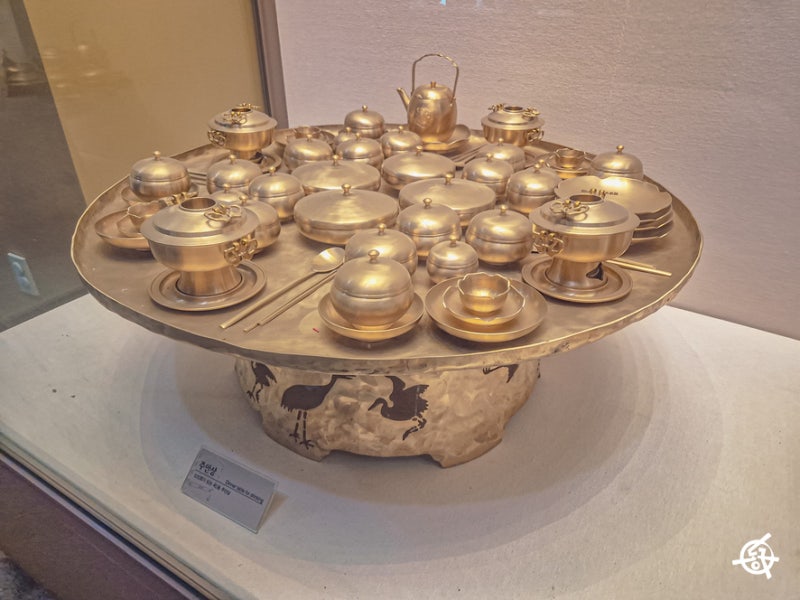
Bangeojjagi Brassware: 1,489 Pieces Donated by Lee Bong-ju at the Foot of Palgongsan
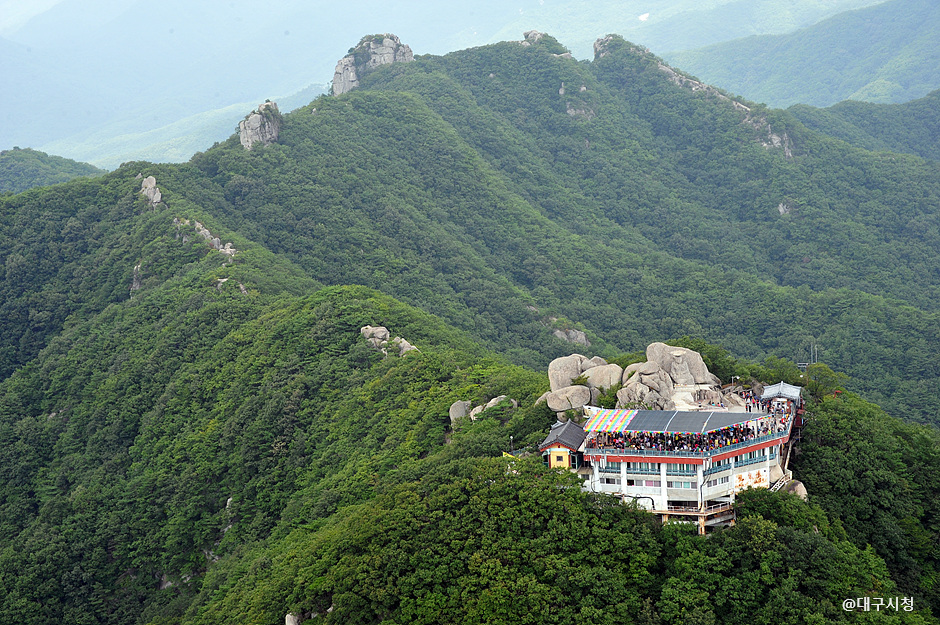 Travel Guide
Palgongsan — From Silla’s Central Mountain to Korea’s 23rd National Park
 Travel Guide
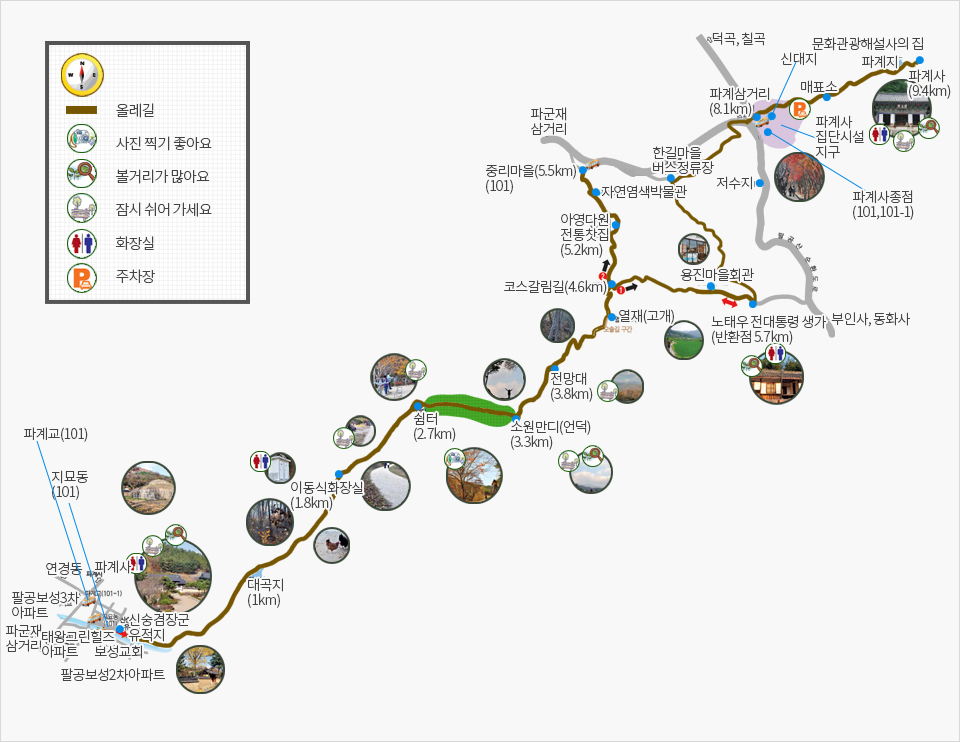
From the Remnants of the Battle of Gongsan in 927 to Pagyesa, Hansilgol 9.4 km
 Travel Guide
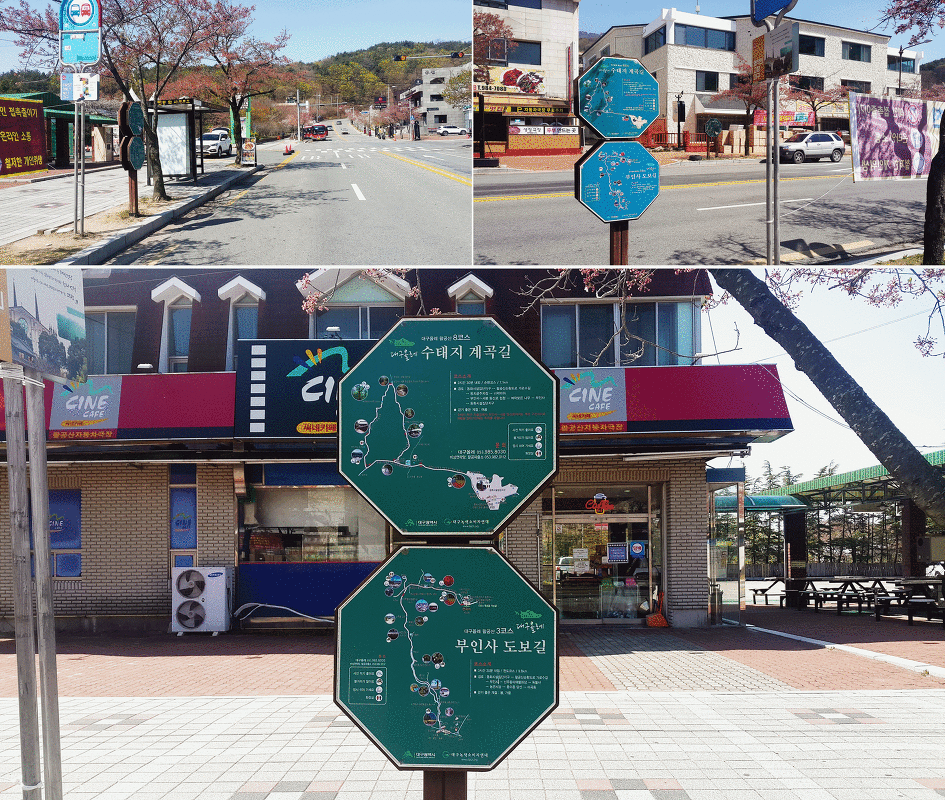
7.1 km Connecting the Sutaeji Valley on Palgongsan, from Donghwasa Terminus to Buinsa
Korea News
 News
News
‘NewJeans Expulsion’ Danielle Releases Her First YouTube Video… “We Don’t Know What Will Happen Next”
![aespa’s North American Tour Has Remaining Seats Despite ‘$49’ Bargain Prices… A Stark Popularity Gap with KATSEYE [TEN Starfield]](https://kotourlive-images.s3.ap-northeast-1.amazonaws.com/news/1788485037424_a59b1932_naver_rank_thumb_0000774618_1788485037424.jpg) News
News
aespa’s North American Tour Has Remaining Seats Despite ‘$49’ Bargain Prices… A Stark Popularity Gap with KATSEYE [TEN Starfield]
![[Photo] TWICE’s Dahyun attends a film festival red carpet as an actress](https://kotourlive-images.s3.ap-northeast-1.amazonaws.com/news/1788485316508_edd43ecd_news_870a60a6-6f11-4d73-aa7c-48d91318a0f7.jpg) News
News
[Photo] TWICE’s Dahyun attends a film festival red carpet as an actress
![[On-Site Video] “We’re Departing Separately Together”… BIGBANG Begins ‘COSMOS’ World Tour](https://kotourlive-images.s3.ap-northeast-1.amazonaws.com/news/1788485226518_c5719641_news_fdd4764a-0f4e-4968-8e4e-e98a02872f88.jpg) News
News